How to Humanize AI Text Without Losing Meaning, Facts, or Citations
Humanizing AI text has two jobs that pull against each other: the rewrite has to keep your meaning, facts, voice, and citations intact, and the result still has to survive review — by a detector, an editor, or a grader who knows how you write. Most humanizers only chase the second job, and only temporarily, by wrecking everything that made the text yours.
This guide covers why most "undetectable" rewrites fall apart on inspection, and how to humanize AI text so it holds up to review without meaning drift, word salad, or broken citations.
TL;DR: Key Takeaways
- The hard part isn't the AI score — it's keeping your meaning, facts, voice, and citations while you change how the text reads. A rewrite that "passes" but says the wrong thing has failed.
- Synonym-swap humanizers fail twice: any human reader hears the thesaurus, and detectors trained on that output catch it anyway. (How detectors flag text covers the mechanics.)
- Real humanization rewrites structure and cadence, not just vocabulary — that's what reads as human and keeps the writing clear.
- Protect the payload during the rewrite. Names, numbers, quotes, and citations must survive untouched; a low AI score is worthless if the text no longer says what you meant.
- Verify, don't assume. Run the output through a detector yourself, close to when it matters — no tool's "undetectable" claim is your result.
Why AI Text Gets Flagged in the First Place
Detectors don't read for meaning — they measure statistical patterns like uniform sentence rhythm and predictable, low-surprise word choice, and flag text that's too smooth and machine-regular to read as human. The full mechanics are their own subject, covered in how detectors flag text; what matters here is the consequence — detectors flag how text is written, not what it says, which is exactly why you can fix the statistics without destroying the content.
The Word-Salad Trap: How Most Humanizers Wreck Text
The obvious shortcut — swap words for synonyms until the statistics change — is what most cheap humanizers do. Here's what that actually produces.
Original AI text:
Starting a new hobby is a common way people spend free time. A hobby can be something simple, like gardening, drawing, or learning a language.
Typical synonym-swap humanizer output:
A great many individuals use a hobby as a means of spending free time. Hobbies may range in simplicity (garden, draw, learn a language), and in addition to these there are many other options available to a potential hobbyist.
Notice what happened:
- "People" became "a great many individuals"
- "To spend" became "as a means of spending"
- The sentence grew 30% longer without adding information
- It now reads like someone swallowed a thesaurus
This output has two fatal problems:
- Humans catch it instantly. A grader, editor, or client doesn't need GPTZero to see that "a potential hobbyist" is not how you write. Awkward text invites the scrutiny you were trying to avoid.
- Detectors catch up. Vendors train on humanizer output, so a synonym-swap rewrite that passed last semester can get flagged today — sometimes as both AI-written and AI-paraphrased. The detector-side mechanics are their own subject (how detectors flag text); here the point is simpler: the shortcut doesn't even buy you time.
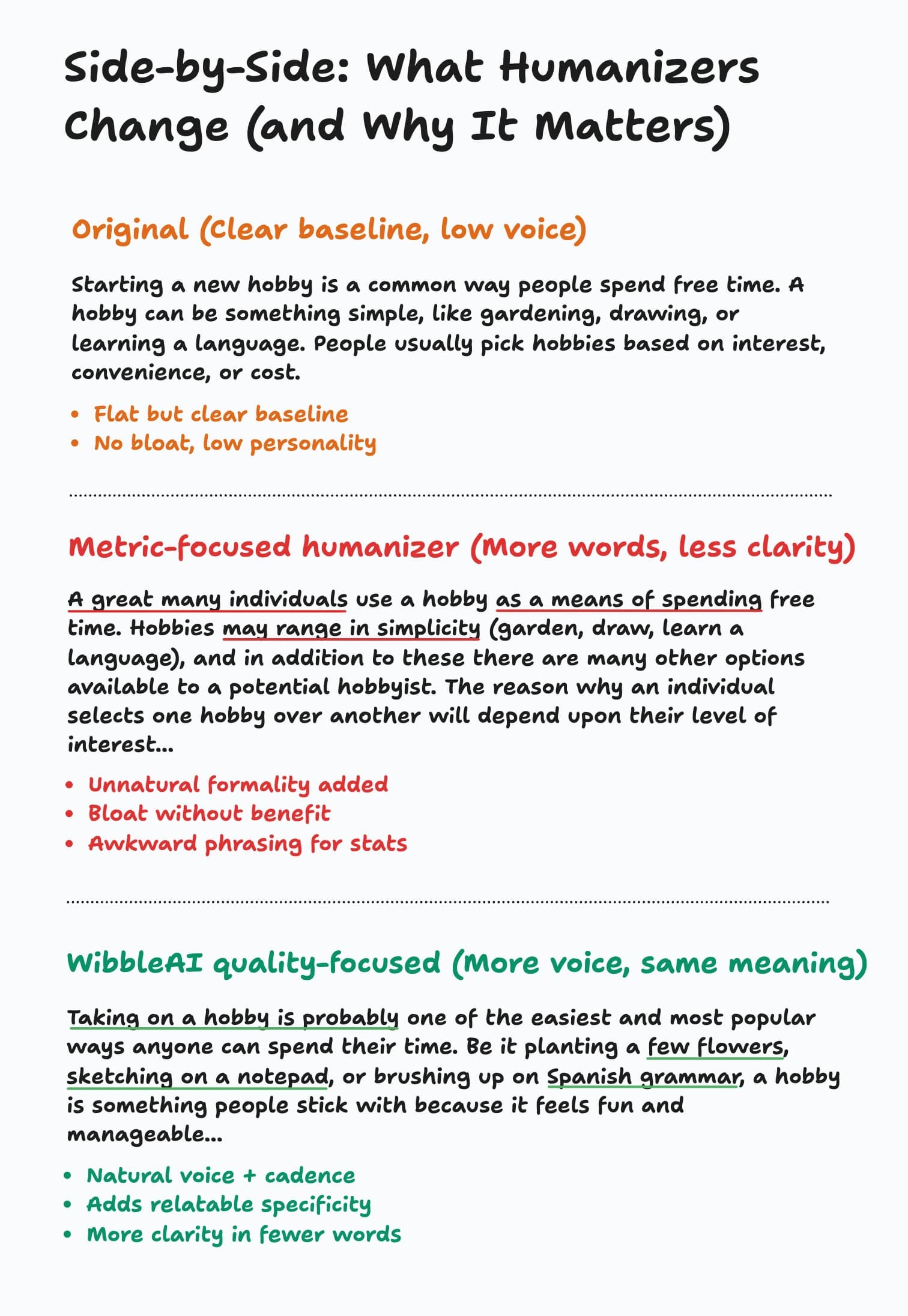 Synonym-swapping adds bloat and gets flagged anyway; structural rewriting changes the statistics detectors measure.
What Actually Makes Writing Read as Human
Human writing differs from AI writing in ways that go deeper than vocabulary. These are the qualities worth rebuilding when you humanize — the ones a reader responds to (and, not by coincidence, the ones detectors measure):
Varied sentence structure. Not random variation — variation driven by content. Big claims get short sentences. Nuanced points sprawl. Humans mix simple, compound, and complex constructions instinctively.
Natural cadence. Real writers create rhythm: setup, payoff, pause. Read your text aloud — if every sentence has the same beat, so will the statistics.
Contextual word choice. Humans pick words by connotation and register, not just meaning. "Help" instead of "assist" in casual writing. The occasional informal shortcut. Word choices a model rates as slightly unlikely are exactly what makes text read as human.
Consistent voice. One recognizable perspective throughout. Humanizers that randomize tone sentence-by-sentence produce text that's statistically diverse but obviously broken.
Opinion and commitment. AI drafts hedge relentlessly ("it could be argued that..."). Humans commit to claims. Cutting hedges changes both the statistics and the persuasiveness.
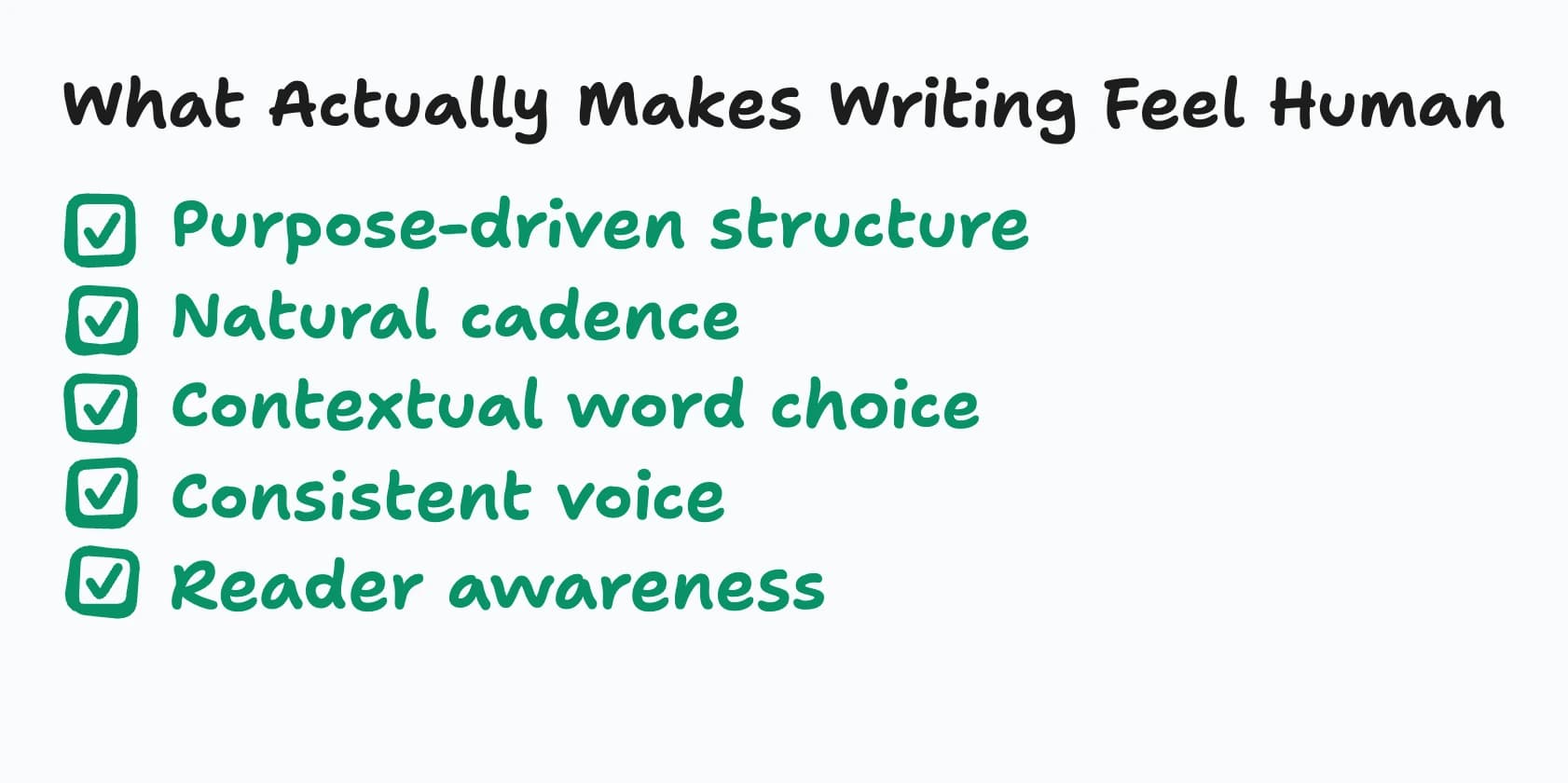 The signals that make writing read as human are the same ones detectors measure.
How to Humanize AI Text by Hand (the Method)
If you're rewriting manually, work through these steps in order:
1. Restructure before you reword. Merge two robotic sentences into one. Split a long one. Move the point of a paragraph from the first sentence to the last. Structural changes move detector scores far more than vocabulary changes — and they're invisible to bypasser-detection, because you're producing genuinely different text rather than a masked version of the same text.
2. Break the rhythm. Find three consecutive sentences with the same shape and rewrite the middle one. Add a short declarative sentence after a long one. Use a fragment where it lands.
3. Rewrite in your register. Replace the essay-voice phrases AI defaults to ("delve into," "it is important to note," "in today's fast-paced world") with how you actually talk about the topic. If you wouldn't say it, don't submit it. A free AI phrase finder highlights these tells so you know what to cut.
4. Cut the hedging, keep the caveats that matter. Delete filler qualifiers. Where uncertainty is real, state it plainly ("this only held for short texts") instead of vaguely ("results may vary").
5. Protect the payload. Names, numbers, quotes, and citations must survive the rewrite untouched. Check every one after editing — a free integrity checker diffs the two versions and flags anything that changed. This is where manual rewriting is safest — and where cheap tools do the most damage.
6. Verify. Run the result through the detector you actually care about, or a free one as a proxy. Don't trust any tool's claim that text "passed" detectors it never ran.
Done properly, this takes 20–40 minutes per 500 words. It works. It's also the reason humanizer tools exist — most people flagged the night before a deadline don't have those minutes per paragraph.
Where Tools Fit: Structural Rewriting at Scale
A humanizer is worth using only if it automates the structural method above, not the synonym-swap shortcut. This is the difference Wibble is built around: its Deep Linguistic Analysis engine rewrites how ideas are expressed — sentence structure, cadence, syntactic patterns, register — rather than masking which words express them.
Here's the same hobby passage through Wibble:
Taking on a hobby is probably one of the easiest and most popular ways anyone can spend their time. Be it planting a few flowers, sketching on a notepad or reminding yourself of Spanish grammar rules, a hobby is something a person pursues for being fun, manageable and inexpensive.
Compare that to the "great many individuals" version above. The structure changed, the rhythm changed, the meaning didn't — and it reads like a person wrote it. That last part isn't a nice-to-have: output a human reader would accept is the only kind of "undetectable" that survives contact with an actual reviewer.
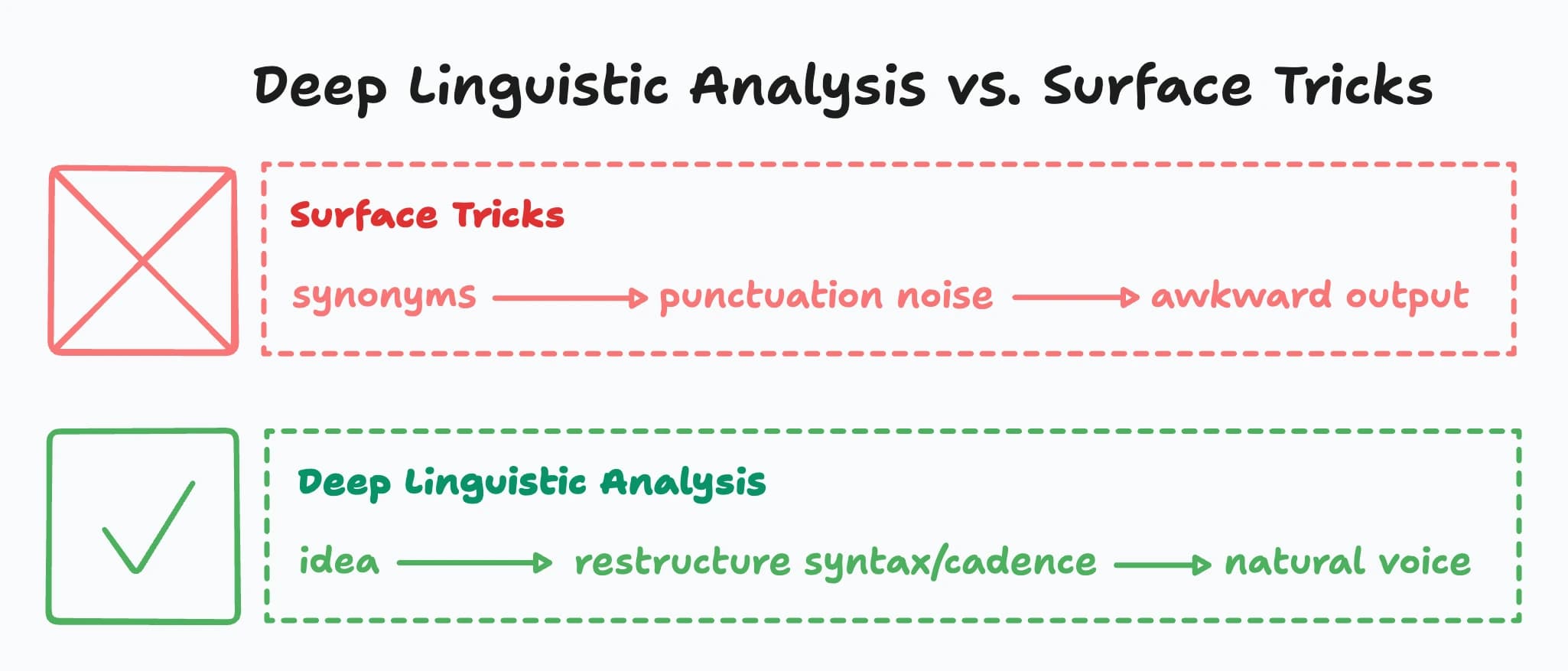 Surface tricks mask words; structural rewriting changes the patterns detectors measure.
Whatever tool you evaluate, test it on these failure modes before trusting it:
- Meaning drift: does a claim in the output still say what the input said?
- Citation damage: do author names, years, and quoted text survive intact? (Wibble preserves citations and quotations by design; most tools mangle them.)
- Word salad: read one output paragraph aloud. If you stumble, a grader will too.
- Keyword loss: for SEO content, check that the terms you rank for are still in the text.
- Detector results: run the output through a detector yourself. Marketing screenshots are not your results.
Try it on the paragraph that got flagged:
Verify It Worked — and Know the Limits
Two honest caveats that most humanizer marketing skips:
Detectors move, so verify against a current one. Any tool claiming permanent, universal undetectability is lying to you — how detectors flag text covers why the target keeps shifting. What holds up over time is text whose structure is genuinely human-like, not a trick that worked once.
A detector score is not proof of authorship — in either direction. Detectors produce false positives on real human writing (especially formal, polished, or non-native English) and false negatives on AI text. If you're accused over a score alone, that's challengeable. And if your humanized text scores 0%, that's evidence it reads human, not a certificate.
The practical standard: rewrite structurally, protect the meaning and citations, then check the output against the detector that matters to you, close to the time it matters. That's the workflow Wibble automates — and you can verify every output yourself, which is exactly how it should be.
Paste the paragraph that got flagged
300 words free. No account. Run the output through any detector and see for yourself.
Frequently Asked Questions
Can AI detectors be bypassed?
Yes — text rewritten with genuinely human structure, cadence, and word choice passes current detectors. What doesn't hold up is synonym-swapping: detectors like Turnitin now specifically flag AI-paraphrased text, and vendors retrain on humanizer output. Always verify against a current detector rather than trusting a tool's claim.
Does humanizing AI text change its meaning?
It shouldn't, but with most tools it does. Aggressive synonym replacement drifts claims, mangles numbers, and breaks citations. Good humanization rewrites structure and cadence while preserving names, figures, quotes, and citations — check all of them after any rewrite.
Why does humanized text still get flagged sometimes?
Usually because the rewrite only changed vocabulary, not structure — or because the detector updated since the tool's training. Turnitin added explicit bypasser detection in 2025 and updated its model again in 2026. Structural rewriting verified against current detectors is the reliable approach.
Are AI detector scores proof that text is AI-written?
No. Detectors have documented false positives on human writing — especially formal, polished, or non-native English — and false negatives on AI text. Scores are statistical estimates, not evidence of authorship, and even Turnitin says its scores shouldn't be the sole basis for action.
What's the difference between a humanizer and a paraphraser?
Paraphrasers swap wording while keeping structure — which is exactly the pattern bypasser detection flags. A real humanizer rewrites sentence structure, rhythm, and register so the statistical profile of the text changes. That's what moves detector results.
Does running text through a humanizer twice help?
Rarely. If the tool does structural rewriting, one pass does the work. If it's a synonym-swapper, a second pass compounds the word salad without fixing the underlying regularity. A second pass through a different weak tool usually makes text less readable and no less detectable.
Is it safe to humanize text with citations in it?
Only with tools built for it. Most humanizers treat citations as ordinary text and rewrite author names, years, and quotes. Wibble preserves citations and quotations through the rewrite; whatever tool you use, diff every citation against the original before submitting.
Sources and verification
Paste the paragraph that got flagged
300 words free. No account. Run the output through any detector and see for yourself.
Keep reading
How to Bypass AI Detection in 2026: What Works and What Ruins Your Text
Every way to bypass AI detection in 2026, ranked — why prompt tricks and paraphrasers fail, what actually works, and how to verify without ruining your text.
Why Is My Writing Flagged as AI? 12 Causes and Fixes
Why is my writing flagged as AI? The 12 real causes — from uniform rhythm to over-editing — with a fix for each, plus what to do if you're falsely accused.
How to Humanize AI Text Without Breaking Citations
Humanizers rewrite author names, drift years, and fabricate quotes. How to humanize AI text without breaking citations — plus a checklist that catches damage.